
Hotel Technology, Reconsidered: Part 4 of 4
Hotel technology decisions rarely affect just one system. A network investment can influence guest Wi-Fi, in-room entertainment, security, staff communications, and future connected services. The decisions hotels make today can shape costs, operations, and guest experiences for years to come.
In Part 1 of this series, we explored how short-term technology decisions can lead to expensive rework. Part 2 examined the operational costs of reactive IT. Part 3 looked at the coordination burden created by fragmented technology vendors.
Those challenges share a common thread: technology decisions made in isolation can create problems elsewhere in the property.
The answer is not simply to buy fewer tools. Hotels need a coordinated strategy that considers how systems fit together, how they will be supported, and how they will evolve. An integrated approach connects technology planning, implementation, operations, and future investment within one lifecycle strategy.
Start With the Entire Technology Ecosystem
Every hotel has its own mix of buildings, brand standards, guest expectations, operational priorities, and existing technology. A successful strategy accounts for those differences while considering how individual systems depend on one another.
For example, a hotel may invest in new guest Wi-Fi access points to improve connectivity. However, if the cabling, switching, internet connection, or network design cannot support demand, the investment may not deliver the expected results. The same infrastructure may also support in-room entertainment, mobile keys, security systems, and other connected technologies.
Hitesh Patel, Vice President of Solution Architecture at WorldVue, emphasizes the importance of designing for the entire environment. “Today’s hotel network supports much more than guest Wi-Fi. It can support property operations, IPTV and streaming, mobile key, IoT devices, security systems, building controls, staff communications, and other connected technologies.”
That interconnectedness makes early planning essential. Rather than evaluating each technology independently, hotel leaders should consider how a proposed investment affects the wider environment, what other systems depend on it, and what future requirements the infrastructure must accommodate.
Integration is not simply a feature of individual products. It is an operating model that shapes long-term cost, complexity, and performance. The goal is to create a technology environment in which systems, infrastructure, and support processes work together.
The Hotel Technology Lifecycle
An integrated strategy extends beyond selecting and installing equipment. It considers the full lifecycle of each investment, from initial planning through ongoing support and eventual replacement.
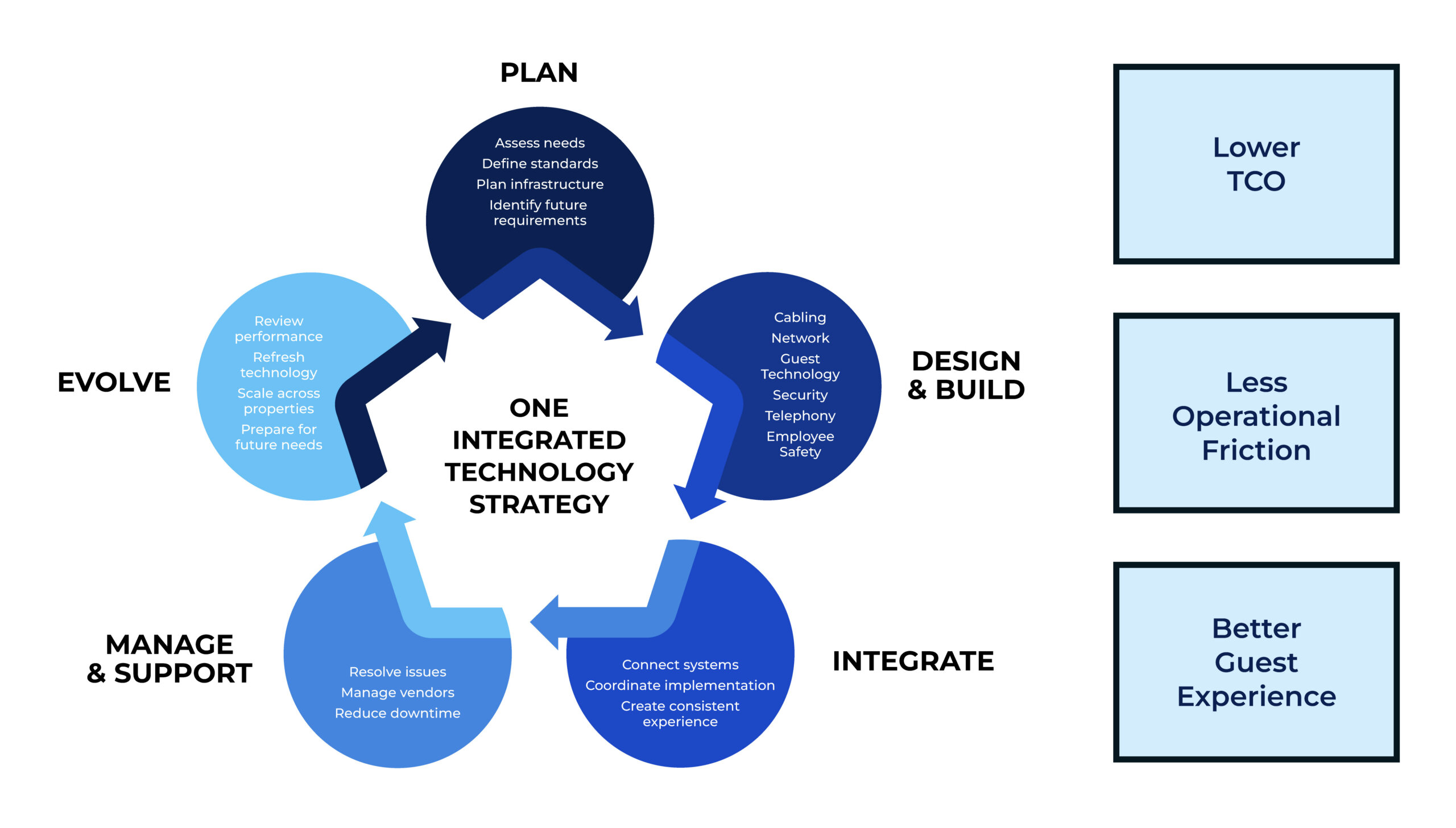
This lifecycle approach helps hotels evaluate technology as an ongoing investment rather than a series of unrelated purchases. It also creates opportunities to identify dependencies earlier, coordinate work more effectively, and plan upgrades before aging systems become operational constraints.
Make Standardization a Strategic Advantage
Standardization can help hotels manage technology more consistently, especially across multiple properties. Shared infrastructure principles, preferred configurations, documentation practices, and support processes can simplify implementation and ongoing management.
However, standardization does not mean every property must use identical technology. Hotels still need room for differences in building design, market position, brand requirements, and guest expectations. The goal is to establish consistent foundations while allowing appropriate flexibility.
A portfolio-wide approach can also simplify planning for future projects. Teams can build on established designs, apply lessons from earlier deployments, and evaluate new technology against known requirements. That reduces the need to start from scratch with every investment.
Standardization is most valuable when it supports the broader technology roadmap. Rather than creating uniformity for its own sake, hotel leaders can use shared standards to improve compatibility, simplify support, and make future changes easier to manage.
Design for the Guest Journey, Not Just Individual Services
Guests experience a hotel as one property, not as a collection of technology systems. They expect connectivity, entertainment, and digital services to work reliably throughout their stay. When those experiences are disconnected, guests may notice the friction even if each individual system appears to function as designed.
That makes guest technology strategy a broader consideration than simply choosing an entertainment platform or improving Wi-Fi. Hotel leaders should consider how digital touchpoints support the guest journey, reinforce the brand, and fit how the property delivers service.
Ryan Landes, Vice President of Loyalty & Strategic Development at WorldVue, describes the opportunity in guest room television. “For TV services, I think it is when a customer sees there is a true partnership building their brand message. They aren’t just adding a service; they are enhancing the guest experience.”
The principle extends beyond television. Guest-facing technology should support the property’s brand and service goals while fitting into the wider technology environment. That requires coordination between the teams responsible for technology, operations, marketing, and the guest experience.
It also means looking beyond an individual product’s features. Hotel leaders should consider how a solution will integrate with existing systems, support future services, and contribute to a consistent experience across the property.
Build Security into the Architecture
Consider security and compliance during technology planning and design, not only after a problem arises. Connected systems rely on shared infrastructure, so decisions about network architecture, device configuration, access, and ongoing management can affect the broader security environment.
An integrated approach helps teams consider these dependencies together. For example, network segmentation, appropriate access controls, system documentation, and planned monitoring can support a more deliberate approach to managing connected devices and services.
The specific requirements will vary by property, technology, and applicable standards. Hotel leaders should work with qualified technology and security professionals to identify the relevant obligations and incorporate them into the design and operating plan.
The objective is not to treat security as a separate project that ends at installation. Instead, make security considerations part of the technology lifecycle, with clear responsibilities for implementation, maintenance, monitoring, and future changes.
Make Monitoring an Ecosystem-Wide Capability
Technology needs change after installation. Guest demand fluctuates, devices age, software evolves, and new systems place additional demands on existing infrastructure. Ongoing monitoring and support help hotels understand how their technology performs and respond when conditions change.
When monitoring is limited to isolated systems, teams may have difficulty seeing how a problem affects the wider environment. A broader view can help connect the dots between network performance, connected services, support activity, and recurring issues.
An integrated support model can also clarify ownership. Hotel teams should understand who monitors each system, who responds to alerts, how issues are escalated, and how information is shared when a problem crosses technology boundaries.
Proactive monitoring does not eliminate every outage or service issue. Rather, it helps establish a more consistent way to identify problems, investigate their causes, and support reliable operations. When paired with documentation and lifecycle planning, it can also inform decisions about capacity, maintenance, and future investment.
Choose a Partner That Can Support the Whole Lifecycle
Technology selection should account for more than the initial proposal. Hotels need to understand how a provider will support the solution after installation, how it will work with other systems, and whether it can help the property adapt as requirements change.
That calls for a broader evaluation than comparing feature lists and upfront prices. A solution may appear less expensive initially but become more burdensome if service is unreliable, support responsibilities are unclear, or the technology doesn’t fit the property’s longer-term needs.
Landes cautions that vendor offerings and support can differ significantly. “From a distance, features and functionality can look very similar between vendors. However, there can be significant differences in both the technology offered as well as quality of service after the sale.”
Hotel leaders should evaluate a potential partner’s technical capabilities, service model, integration experience, and ability to support the property’s needs over time. They should also understand how the provider coordinates with other vendors when a solution depends on systems outside its direct control.
Useful questions include:
- How will this investment fit into the property’s existing technology environment?
- What other systems will depend on it?
- Who is responsible for integration, documentation, and ongoing support?
- How will issues be escalated when multiple technologies are involved?
- Can the provider support future upgrades, expansion, and changing requirements?
- What service commitments and support coverage will apply after installation?
A single experienced partner may help coordinate multiple technology areas. However, the arrangement still needs clear responsibilities, suitable technical capabilities, and appropriate service commitments. The objective isn’t simply to reduce the number of vendors but to establish an accountable operating model that makes the technology environment easier to manage.
Measure Success Beyond the Installation
A project can meet its installation deadline and still fall short of its longer-term goals. The technology must continue to serve the property, support employees, and meet guest expectations after the project team has moved on.
That is why the evaluation should include total cost of ownership (TCO) from the start. The initial purchase price is only one part of the investment. Hotels should also consider ongoing support, maintenance, integration, staff effort, future upgrades, and the potential cost of premature replacement or avoidable disruption.
Chris Guthery, Senior Vice President of Sales and Product at WorldVue, emphasizes long-term value. “Total cost of ownership should be at the forefront of any technology investment for property owners. Often, the lowest-priced option ends up costing the most over time. Measure this by guest satisfaction, operational reliability, and revenue impacts, not by the initial size of the invoice.”
Those measures help connect technology decisions to the property’s broader goals. Depending on the investment, hotels may assess system reliability, support demands, guest feedback, implementation consistency, or the time employees spend managing technology issues.
The most useful measures will vary by property and project. Establishing them early, then reviewing performance over time, helps hotel leaders understand whether the investment is delivering its intended value and where adjustments may be needed.
Hotel Technology, Reconsidered: What’s Next?
Across this four-part series, we have examined the hidden costs of short-term technology decisions, reactive IT, and fragmented vendor relationships. Each creates a different kind of burden, from rework and downtime to additional coordination and operational complexity.
An integrated strategy offers a way to address those challenges at their source. It connects planning, infrastructure, systems, support, and future investment so that decisions made in one area account for their effects elsewhere.
The next step is turning that principle into a practical decision-making framework. WorldVue’s upcoming Executive Guide will bring together insights from in-house experts and technology partners, along with frameworks for evaluating providers, questions to ask before committing to an investment, and ways to assess costs and operational responsibilities across the technology lifecycle.
The guide will help hotel leaders look beyond the initial proposal and evaluate whether a technology partner can support the property’s needs today and as they evolve.
Build a Technology Strategy That Supports the Whole Property
The strongest hotel technology strategy is not built around individual products. It starts with the property’s needs, considers how systems and infrastructure work together, and plans for the full lifecycle of each investment.
That approach can help hotels reduce avoidable complexity, make better-informed investment decisions, and build a technology environment that supports both guest experience and daily operations. It also gives hotel leaders a clearer basis for evaluating partners, defining responsibilities, and planning for future needs.
WorldVue helps hospitality properties plan, implement, and support technology across the property. To explore how an integrated approach can support your hotel’s technology goals, visit our website.