

Hotel Technology, Reconsidered: Part 3 of 4
A hotel may rely on dozens of technology solutions every day. Wi-Fi, in-room entertainment, telephony, security, employee safety, and other connected systems all serve different purposes. They may also come from different vendors.
That can work well when each system operates independently. The challenge, however, comes when those systems need to work together.
Every additional vendor can mean another contract, support relationship, renewal cycle, project manager, and escalation path. Someone at the hotel must coordinate those relationships. When an issue crosses systems, someone must determine which vendor(s) to involve.
The technology may be separate, but the operational burden is not. That is the hidden cost of vendor fragmentation.
Part 1 of this series examined how short-term technology decisions can create long-term rework. Part 2 looked at the operational cost of reactive IT. Part 3 now looks at another source of operational friction: managing multiple technology vendors across the property.
The Technology Friction Hotels Don’t Always See
Adding another hotel technology vendor can seem like a straightforward decision. A hotel needs a particular solution. A vendor provides it, the hotel signs the contract, and the installation happens.
Once the technology goes into service, the work doesn’t necessarily end there.
Now the hotel has another relationship to manage. There may be another invoice, another renewal date, another support number, and another team that needs information about the property’s technology environment.
Multiply that across several systems, and the administrative burden grows. The issue isn’t simply the number of vendors, but the number of connections between them.
A hotel network may support Wi-Fi, in-room entertainment, phones, security systems, and other connected technologies. A project may require several vendors to coordinate schedules and responsibilities. A technology issue may involve more than one system. That requires multiple companies to determine where one vendor’s responsibility ends and another’s begins.
Every additional vendor creates another potential handoff, and every handoff creates an opportunity for delay, confusion, or finger-pointing.
How Technology Friction Adds Up
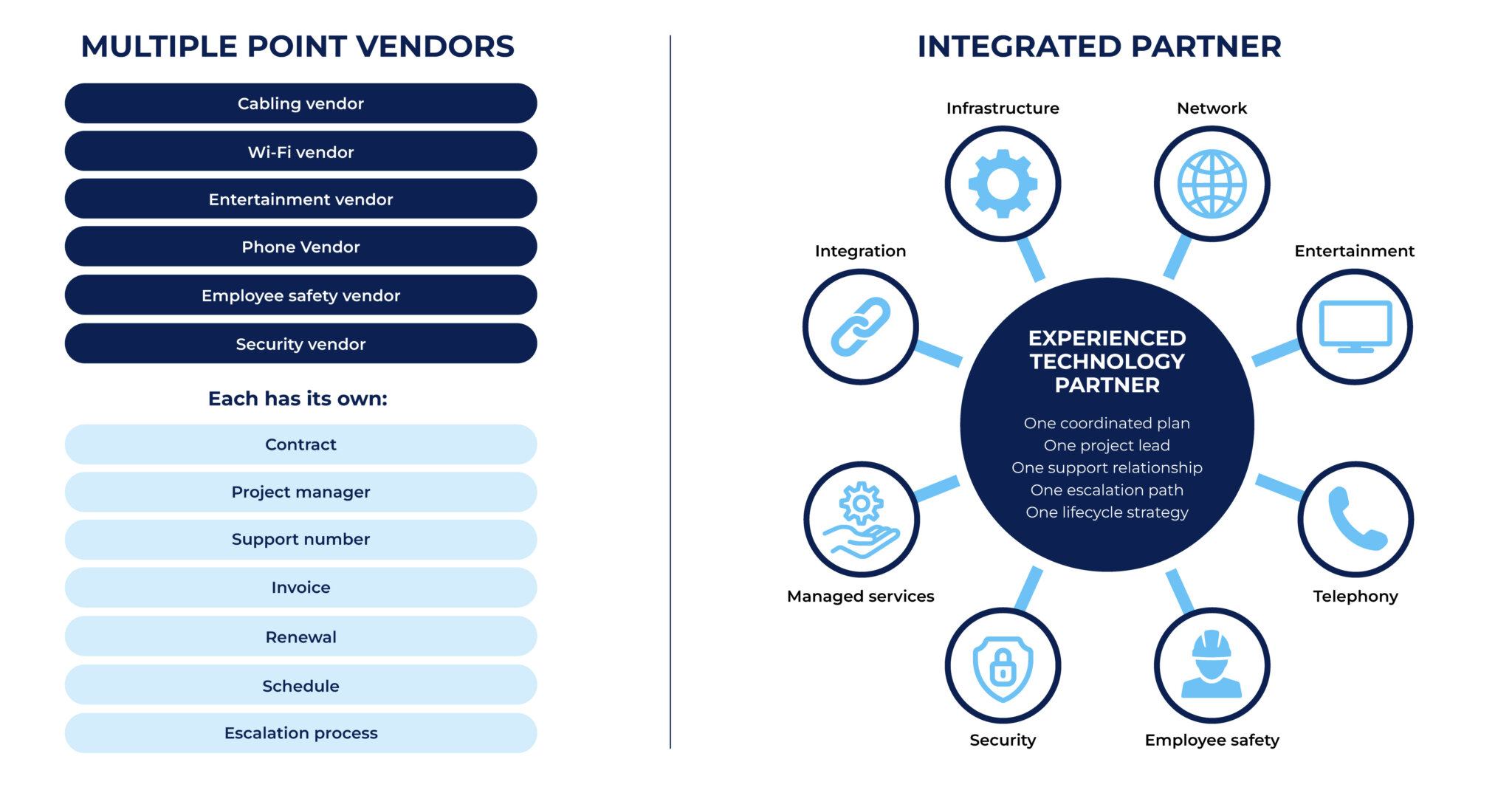
Every Vendor Adds More Than a Contract
Hotels often treat vendor management as an administrative task. In practice, it can affect how quickly a hotel gets work done.
Consider a hotel with separate providers for cabling, Wi-Fi, entertainment, phones, employee safety, and security. Each provider may perform its own role well, but the challenge comes when those roles overlap:
- Who coordinates the installation schedule?
- Who confirms that the network can support the new technology?
- Who handles an issue that crosses systems?
- Who has the documentation needed to understand the existing environment?
- Who calls the other vendors when something does not work as expected?
The hotel team may end up answering those questions. That creates what we call technology friction. The technology itself may not be failing; instead, the processes around it create extra work.
For hotel teams, that work has a real operational cost.
The Hotel Becomes the Coordinator
When vendors operate independently, the hotel often becomes the connection point between them. That can mean more meetings, more emails, and more approvals. It almost certainly means spending more time explaining the same technology environment to different providers.
It can also make accountability less clear.
A technology project may involve several vendors working in sequence. One team’s work may depend on another team’s schedule. A change in one part of the project may require adjustments somewhere else.
Someone must coordinate those dependencies. Unfortunately, that someone may be the hotel.
Jesse Parks, Director of Project Management at WorldVue, describes the difference coordination can make during multi-solution deployments. “In a case where a single integrator manages multiple solutions for the same site, we see a much faster and more seamless installation for all those services.”
He also points to the value of having the right information and resources available before installation begins. Knowing which systems need to be integrated, having information about the existing infrastructure, and coordinating access to guestrooms can reduce downtime and repeat visits.
The point is not that every technology project requires one company, but that someone needs to own the coordination. Without that ownership, the hotel can end up filling the gap.
Integration Is Where Fragmentation Becomes Visible
Disconnected vendors become especially challenging when technologies need to work together.
Today’s hotel technology environment is increasingly interconnected. Guest-facing systems may depend on the network. Phones may depend on network connectivity and other hotel systems. Security and employee safety technologies may rely on shared infrastructure.
That interdependence makes coordination important even when the individual technologies come from different providers.
Technology integration helps ensure systems communicate properly from the outset. It also reduces manual workarounds, compatibility risk, and future retrofit projects when technologies are considered together.
Integration also affects what happens after installation. When multiple technologies share infrastructure, the people supporting those technologies need to understand how they interact. Otherwise, the hotel may have to coordinate several vendors to determine which system is causing a problem.
That is where vendor fragmentation can turn a technical question into an operational one. The problem is no longer simply whether a particular system works, but whether the people responsible for that system can work effectively with the people responsible for everything connected to it.
Projects Multiply the Coordination Challenge
Vendor fragmentation can become particularly visible during a renovation, technology upgrade, or new property opening.
Multiple vendors may need access to the same spaces. Their schedules may overlap. One installation may depend on another being completed first. If something changes, the impact can extend across the project.
This is where project management becomes more than scheduling. It turns into a need for coordination across technology, people, timelines, and responsibilities.
Parks notes that having the necessary information from third-party systems, internal operations, and technology experts can help reduce downtime and repeat visits. If teams know the integration requirements in advance, they can configure the equipment before installation. When teams coordinate guest access, they can move more efficiently through the property.
A single project lead can also give the hotel a clearer point of contact. Instead of coordinating several technology vendors independently, the hotel can work through one organization that understands the broader project.
That does not eliminate project complexity. However, it can reduce the amount of complexity the hotel has to manage itself.
Procurement Doesn’t End When the Purchase Is Made
Vendor fragmentation also changes the meaning of technology procurement.
Hoteliers often evaluate a purchasing decision by comparing the upfront price of competing solutions. However, the purchase creates an ongoing relationship. There may be recurring service costs, renewals, support requirements, upgrades, integrations, and future purchasing decisions.
That means procurement decisions can create administrative work long after the original purchase.
Vendor management reduces the number of contracts, invoices, renewals, procurement cycles, and vendor relationships a property must manage. Technology procurement becomes an opportunity to evaluate solutions based on long-term operational value rather than upfront cost alone.
The point is not that every hotel should consolidate every technology purchase. Instead, hotels should consider the management implications of each decision.
Before adding another vendor, it is worth asking:
- Who will manage this relationship?
- Who will support the technology after installation?
- What other systems will need to interact with it?
- Who owns the integration?
- How many additional contracts, renewals, and support relationships will this create?
- Who coordinates the vendors if a problem crosses systems?
Those questions move the conversation beyond the purchase price. They also help reveal costs that may not appear on the initial proposal.
A Fragmented Technology Environment Creates a Fragmented Experience
Vendor fragmentation affects more than just the back office.
Guests experience a hotel’s technology environment as a whole. They do not necessarily know which company provides the Wi-Fi, which company provides the in-room entertainment, or which vendor supports the property’s phones. They simply expect those technologies to work together.
When systems or support processes are disconnected, guests can feel the consequences.
A guest may report a problem to the front desk. The hotel employee may need to determine which vendor to contact. That vendor may then need information from another provider.
The guest sees one hotel, but the hotel may see several vendors. That gap can create friction that reaches the guest experience.
In-room entertainment and guest engagement provide one example. These technologies can support streaming and casting, hotel information, promotions, and other digital guest interactions. When they share infrastructure and can evolve together, the hotel need not manage them as disconnected point solutions.
The same principle can apply to telephony, employee safety, security, and other connected technologies.
The goal is not to eliminate specialized solutions, but to make the guest experience seamless.
One Partner Can Reduce the Need for Coordination, But Does That Always Eliminate Complexity?
Hotels will always have multiple technologies. They will also continue to work with specialized providers and technology partners.
The question is who coordinates the environment.
An experienced multi-solution partner can provide a central point of accountability across multiple technologies. Instead of asking hotel staff to manage every relationship independently, the partner can coordinate implementation, support, and escalation across the solutions it manages.
That can simplify the operational model. It can also make cross-system issues easier to address because one organization has visibility across more of the environment.
Niame Ba, Vice President of Operations at WorldVue, emphasizes the importance of that coordination. “Successful technology deployments require collaboration across all stakeholders,” he says. “No single company or vendor can operate in a silo and expect to deliver the best outcome consistently.”
That is an important distinction. The goal is not simply to replace many vendors with one vendor. It is to reduce unnecessary coordination work while creating clearer accountability for the technology environment.
Look at the Work Behind the Technology
Hoteliers often evaluate technology decisions by asking what a solution does and how much it costs. Those questions matter, but hotels also need to consider what it takes to manage that solution over time.
Every additional vendor can add another relationship. Another contract. Another renewal. Another support process. Another escalation path.
Those individual additions may seem manageable, but together, they can create a significant operational burden.
Part 1 showed how decisions made early in a technology lifecycle can create costs later. Part 2 examined how technology problems can pull hotel employees into troubleshooting and support.
Vendor fragmentation adds another layer to that problem. It can make the hotel responsible for coordinating the very systems meant to support its operations.
The more connected a hotel’s technology environment becomes, the more important coordination becomes.
That means the right question is not always, “Which vendor can provide this technology?” It may be: “Who can help us manage how this technology fits into everything else?”
That shift can change how hotels evaluate technology partners. It moves the discussion from individual products toward the operational reality of managing an interconnected property.
It also sets up the final question in this series: What does a coordinated hotel technology strategy actually look like?
Hotel Technology, Reconsidered: What’s Next?
This is Part 3 of a four-part series examining the hidden costs of disconnected hotel technology decisions and the value of choosing an experienced technology partner.
In Part 1, we looked at how short-term technology decisions can create long-term rework.
In Part 2, we examined how reactive IT can turn technology problems into operational costs.
Here, we looked at what happens when multiple technology vendors create more contracts, support relationships, escalation paths, and coordination work for hotel teams.
In Part 4, we will bring those ideas together by looking at what an integrated hotel technology strategy can look like.
The series will then culminate in an upcoming Executive Guide. There, we’ll delve deeper into the business case for integrated hotel technology. We will bring together insights from WorldVue experts and technology partners. We’ll also present questions hotel leaders can use to evaluate partners, understand lifecycle costs, and reduce operational friction.
The goal is not simply to manage more technology with fewer vendors. Instead, the goal is to create a technology environment that creates less operational friction in the first place.
Reduce the Operational Burden of Hotel Technology
An experienced technology partner can help hotels coordinate multiple technology solutions while reducing the operational work required to manage them. Learn how WorldVue can help your hotel build and support a more connected technology environment.