

Hotel Technology, Reconsidered: Part 1 of 4
The lowest technology bid can be tempting. It can also become one of the most expensive decisions a hotel makes.
That does not mean the highest-priced solution is always the right choice. Rather, it means hotel technology decisions should account for more than the initial purchase price.
A technology purchase rarely exists in isolation. Cabling supports the network. The network supports connected systems. Those systems may need to expand, integrate, or change as the property evolves.
When the original infrastructure cannot support those changes, the hotel pays again.
It may pay through rewiring, redesigns, change orders, service disruptions, or premature replacements. Staff may also spend time coordinating fixes that better planning could have prevented.
This is the hidden cost of technology rework.
The real cost starts before installation
Technology costs do not begin when equipment arrives at the property. Instead, they begin with the decisions made during planning, design, and procurement.
Some decisions are easy to change later. Others are not.
Cabling, pathways, IDF and MDF locations, power, fiber, and network architecture can be difficult and expensive to modify once construction or renovation is complete. That makes these decisions especially important.
As Nikki Patel, Senior Director of Engineering at WorldVue, explains, “The biggest decisions are usually the ones that are difficult or expensive to change later: cabling, network architecture, IDF/MDF locations, power, fiber.”
Hotels should design physical and logical infrastructure with future technologies in mind, not just today’s requirements.
That distinction matters because hotel technology continues to evolve. A network that meets today’s requirements may face very different demands several years from now. More access points, IoT devices, IPTV, IP phones, cameras, EV chargers, building systems, or other connected technologies can all affect the underlying infrastructure.
The equipment may change. The foundation is harder to change.
For hotels planning new construction or major renovations, this is where hotel technology infrastructure deserves attention before selecting equipment. A technology plan should consider the property’s broader needs rather than treating each system as a separate purchase.
Cabling is the foundation – and it can have lasting effects
Structured cabling is easy to overlook because guests never see it. Yet it anchors much of the hotel’s technology environment.
A well-designed cabling system accounts for current requirements and future growth. It documents every run and follows industry best practices. Most importantly, it considers how the property’s technology ecosystem will evolve.
That planning can prevent problems later.
For example, adding technology can expose limitations in existing cabling, switching, power, or other infrastructure. The result may be additional work that was never part of the original project.
That can mean:
- Rewiring
- Redesign
- Change orders
- Additional site visits
- Installation delays
- Premature upgrades
- Guest or operational disruption
The issue is not simply whether the original cabling works today. The better question is whether it can support what the hotel expects to add tomorrow.
The true cost of a “cheap” technology decision
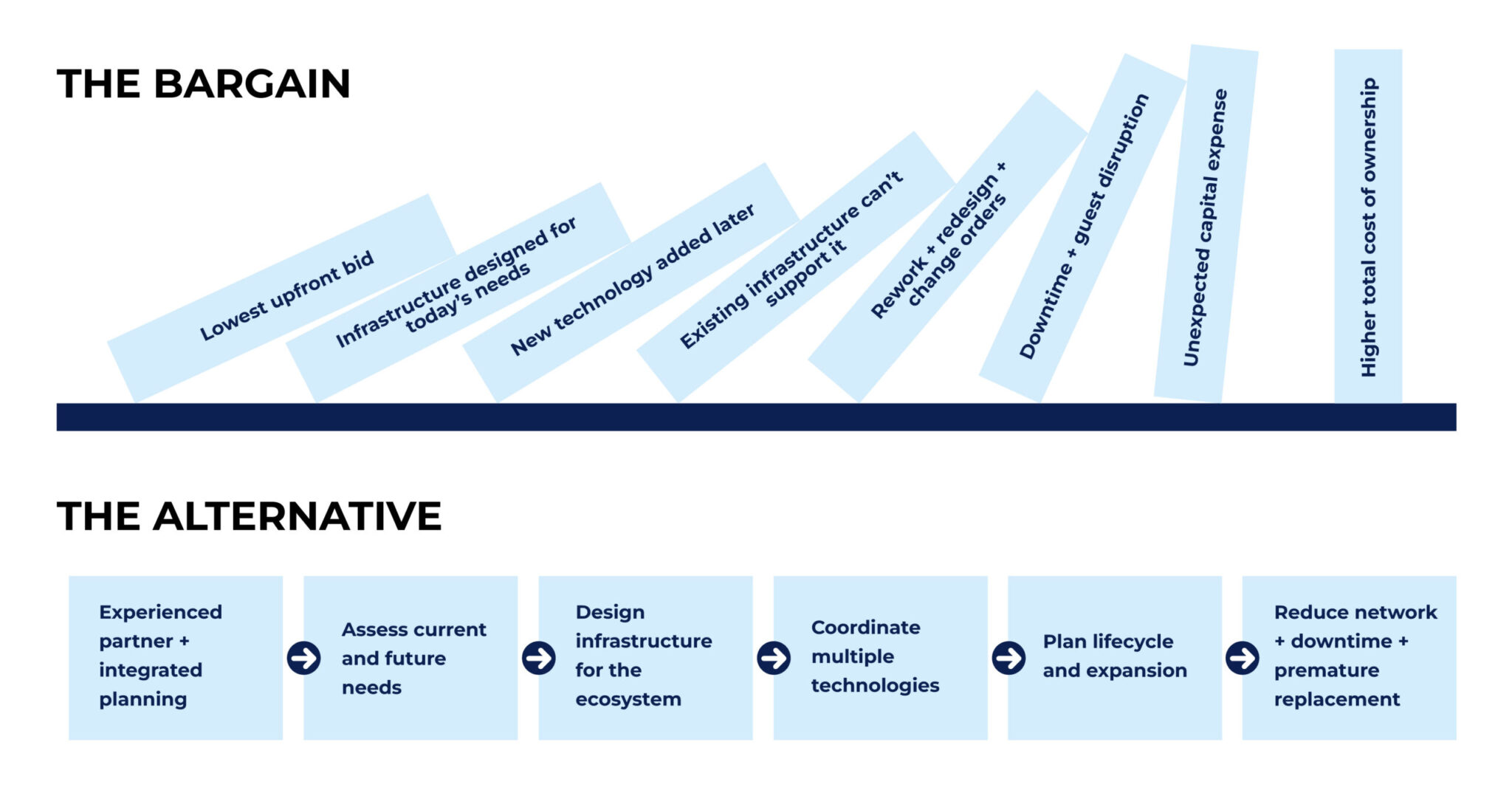
A one-off technology decision can create downstream costs
Consider a hotel that adds technology one project at a time.
First, it installs infrastructure based on current requirements. Later, it adds more connected devices. Then it upgrades another system. Eventually, the original infrastructure becomes a constraint.
The problem may not belong to any one technology. Instead, it may stem from whether teams planned those technologies as part of an ecosystem.
For example, adding more wireless access points can affect switch ports and PoE capacity. Additional connected systems can affect bandwidth, uplinks, IP addressing, VLANs, and firewall capacity.
The same principle applies to guest-facing technologies. An IPTV or streaming upgrade may depend on network capacity and infrastructure that were not part of the original entertainment decision.
Hitesh Patel, Vice President of Solution Architecture at WorldVue, puts the broader issue simply: “Today’s hotel network supports much more than guest Wi-Fi. It can support property operations, IPTV and streaming, mobile key, IoT devices, security systems, building controls, staff communications, and other connected technologies.”
That interdependence matters during planning. As Hitesh notes, “A decision about Wi-Fi, switching, IPTV, security, IoT, or another system can impact other technologies across the property.”
A decision made for one system can therefore affect several others. The result can be a property that technically works on day one but becomes difficult and expensive to scale.
That is technology debt. It can result when a property optimizes an individual project without considering how that decision fits into the larger technology environment.
Like other forms of debt, it may not create an immediate problem. The cost appears later, often when the property needs to change.
Technology debt can make renovations more expensive
Hotels rarely remain static. Properties renovate guestrooms. They refresh public spaces. They add services. They adopt new technologies. Ownership or brand requirements can also change what the property needs from its technology environment.
Those changes become harder when the original infrastructure cannot accommodate them. A hotel may then need to redesign or replace infrastructure that was installed only a few years earlier.
That creates a difficult choice. The property can delay the technology investment, accept the limitation, or spend additional capital to correct the underlying issue.
Better planning cannot eliminate every future technology change. However, it can reduce the likelihood that one change forces several others.
That starts with designing infrastructure around the property’s broader technology roadmap.
It also means coordinating technology decisions before installation begins. Jesse Parks, Director of Project Management at WorldVue, notes, “When we have the right resources available from any third-party systems, internal operations, and/or technology experts, it can go a long way towards reducing downtime and re-visits. If we have the information for the systems we need to integrate with ahead of time, we can configure our equipment in advance.”
The technology itself doesn’t provide the only payoff. Better coordination can help the project move more efficiently and reduce disruption during installation.
The purchase price is only one part of the equation
Technology procurement often focuses on the initial price. That number matters; it just doesn’t tell the whole story.
A lower-priced solution may create additional costs if it does not align with the property’s long-term needs. Those costs can include rework, incompatible purchases, emergency service, premature replacement, and additional staff effort.
An experienced technology partner can approach procurement differently. Instead of evaluating a solution only on what it costs today, the evaluation considers how that solution fits into the property’s technology ecosystem.
That means asking questions such as:
- What will this technology need to support in the future?
- What other systems depend on this infrastructure?
- Can the existing infrastructure support the planned solution?
- What happens when the technology needs to be upgraded?
- Will this purchase create limitations elsewhere?
- How long is the expected useful life?
- What infrastructure will remain when the equipment is replaced?
These questions shift the conversation from purchase price to lifecycle value.
The same principle applies when evaluating technologies that may seem separate from the network or infrastructure. For example, Bryan Wright, Phone Specialist at SparkPlug IP, a WorldVue partner, emphasizes early planning for better technology integration. “One of the most important decisions is planning the voice infrastructure as part of the hotel’s overall technology design from the beginning, rather than treating the phone system as a standalone system at the end of the project.”
That early coordination can prevent later problems and create a system that is easier to deploy, support, and scale as the property’s needs change.
The lesson is broader than telephony. A technology decision is less likely to require rework when teams understand the requirements before the project begins.
Lifecycle planning changes the calculation
A technology investment should not end with installation. Hotels need to consider how they will maintain, upgrade, expand, and eventually replace technology.
Lifecycle planning creates a longer-term roadmap for those decisions. It can help properties reduce premature refresh cycles and make technology investments with the property’s future needs in mind.
It also changes how teams evaluate individual technology decisions.
One system may be approaching the end of its useful life while another still has years remaining. Replacing them independently may make sense in some situations. In others, coordinating the timing can reduce disruption or prevent one upgrade from forcing an unexpected change elsewhere.
The goal is not to replace everything at once, but to understand how the pieces fit together over time. Modern technology solutions have an expected lifespan of three years or more. Thus, properties must plan for the future of their technology.
As Chris Coles, Executive Vice President & Chief Commercial Officer at WorldVue, recommends, “Engage your solution provider in discussion about today, a year from now, and three years from now to ensure due consideration when making technology investments.”
That simple shift in perspective can change the decision.
Standardization and documentation can reduce future complexity
Standardization also has a role in long-term planning. This does not mean every hotel needs identical technology. A property’s needs depend on its size, design, brand, guest expectations, and operations.
However, consistent technology standards can make future work easier. Repeatable standards can simplify support, training, purchasing, and maintenance. Across multiple properties, they can also make acquisitions, renovations, and brand conversions easier to manage.
For a single property, the same principle applies at a smaller scale. The more predictable the technology environment, the easier it can be to understand what is installed, how it connects, and what needs to happen when something changes.
Documentation matters here, too. Without accurate documentation, troubleshooting can take longer because teams must first determine what exists and how it was installed.
Planning and documentation may not be the most visible parts of a technology project. However, they can have an outsized effect later.
Build for the hotel you will have, not just the hotel you have today
Technology equipment will eventually be replaced, but the infrastructure supporting it may be much harder to replace. That makes the planning stage one of the most important opportunities to control long-term technology costs.
The objective is not to predict every technology a hotel will use five or ten years from now. That is not realistic. Instead, design the foundation to give the property flexibility.
That means considering future capacity. It means understanding how technologies depend on shared infrastructure. It means documenting the environment. It means making procurement decisions based on more than the initial invoice.
Most of all, it means treating technology as an ecosystem rather than a collection of individual purchases.
The lowest upfront cost is not always the lowest total cost. The better question is: What will this decision cost the property over its entire lifecycle?
That is where experienced technology planning can make a difference.
Hotel technology, reconsidered: What’s next?
This is Part 1 of a four-part series examining the hidden costs of disconnected hotel technology decisions and the value of choosing an experienced technology partner.
In Part 2, “Why Reactive IT Costs Hotels More Than They Think,” we’ll move from what gets built to what happens after the technology is in place. We’ll examine the operational cost of downtime, reactive support, and network instability.
Later parts will explore the operational friction created by multiple technology vendors. We’ll also look at how hotels can build a more integrated technology strategy.
The goal is not simply to buy better technology. It is to make better technology decisions for the entire property and its lifecycle.
Make the next technology decision with the whole property in mind
WorldVue brings technology expertise, project experience, and relationships across the hotel technology ecosystem. That perspective can help you evaluate today’s requirements while planning for what comes next.