

Guests choose heritage hotels because they offer something unique. Historic architecture, original craftsmanship, and a strong sense of place create memorable experiences that modern buildings often cannot match.
Those same characteristics can make technology upgrades far more challenging.
Today’s travelers still expect fast, reliable Wi-Fi, seamless streaming, and modern in-room entertainment. In Hospitality Technology’s 2025 Guest Engagement Study, 84% of travelers said reliable, secure Wi-Fi is important when selecting a hotel, while 71% value smart TVs and streaming capabilities.
For heritage properties, meeting those guest expectations requires more than installing new equipment. It requires careful planning that respects the building itself.
Every Heritage Property Presents Different Challenges
Whether the property is a centuries-old manor in Europe, a landmark city hotel, or a historic resort in North America, no two buildings are alike.
Many heritage properties include features that deserve preservation, including:
- Original stone, brick, or plaster walls
- Decorative ceilings and millwork
- Historic facades
- Protected architectural elements
- Limited pathways for new cabling
- Construction methods that predate modern communications infrastructure
Unlike in newer hotels, opening walls or installing new conduit may not be practical or even permitted in a historic hotel.
Every technology decision should begin with understanding the building rather than forcing the building to fit the technology.
Guests Expect Modern Connectivity, Not Visible Technology
Guests rarely think about the infrastructure behind their stay. They simply expect everything to work.
Reliable Wi-Fi has become a basic expectation, with the rise of streaming services, device casting, mobile connectivity, and responsive in-room entertainment.
The best technology installations are often the ones guests never notice:
- Access points should blend into the environment whenever possible.
- Cabling should follow existing pathways.
- Network equipment should remain out of sight while delivering consistent performance throughout the property.
Successful Projects Begin Long Before Installation
Every heritage modernization project starts with careful planning. That planning often includes:
- Comprehensive site surveys
- Wireless spectrum analysis
- RF modeling
- Evaluation of existing structured cabling
- Assessment of available pathways
- Coordination with ownership, facilities teams, and preservation stakeholders
Planning reduces surprises during installation and helps minimize unnecessary work that could affect historic features.
Planning Technology Around a Heritage Property
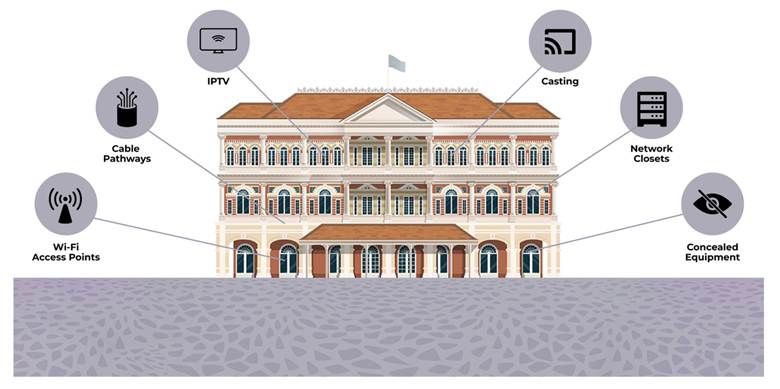
Sometimes the Best Cable Route Is the One You Don’t Build
Running new cable is not always possible. Historic construction, protected finishes, or large open spaces may limit traditional pathways.
In those situations, experienced designers may consider alternative connectivity methods where appropriate. Depending on the property’s layout, point-to-point wireless bridges or other wireless backhaul solutions can connect separate buildings or distant wings without disturbing protected architectural features.
Wireless solutions such as private cellular networks also broaden options for connectivity across hotel properties. Technologies such as Positron’s networking solutions may also help extend connectivity. Such solutions leverage existing infrastructure in situations where installing new cable would be difficult or undesirable.
Every property is different. The right approach depends on the building’s construction, preservation requirements, performance goals, and long-term technology strategy.
An Integrated Approach Reduces Risk
Technology projects become more complex when multiple contractors work independently. A better approach relies on an experienced provider for technology integration.
Coordinating structured cabling, Wi-Fi, IPTV, networking, and guest entertainment as part of a single strategy can reduce repeated work, simplify project management, and help protect historic spaces from unnecessary disruption.
Just as importantly, it creates opportunities to plan for technology holistically rather than solving one problem at a time.
Project Spotlight: Historic Campground and Recreational Facility
A large, historic, multi-building campus has been a year-round destination for locals and visitors alike for many decades. However, the existing Wi-Fi solution was no longer enough to provide the connectivity that guests expected. An updated solution improved performance and reliability campus-wide and even added capacity for IoT solutions. Installers took care to hide wiring and equipment to avoid disrupting the ambiance of the historic buildings
Modern Hospitality Technology, Backed by Decades of Experience
Every hotel has its own story, architecture, and operational needs. Modernizing a heritage property requires more than selecting the right technology. It requires thoughtful planning, hospitality expertise, and solutions designed around the building itself.
For decades, WorldVue has helped hotels integrate Wi-Fi, in-room entertainment, networking, and other guest technologies while respecting the character that makes each property unique. Planning a complete modernization or exploring options for a challenging installation? Our team can help you develop a strategy that supports today’s guest expectations while preserving your property’s legacy.
Contact WorldVue to start planning your next technology modernization project.