

Table of Contents
- Why Hotel Safety Expectations Are Changing
- Where Traditional ESD Models Fall Short
- Room-Level Accuracy without Beacons or Scanning
- Real-Time Communication During Active Incidents
- Introducing SafeStream for Improved Insights
- Get Automatic CCTV Alerts Even When No One Is There to Report
- Direct Connection to First Responders with RapidSOS
- Visual Response Coordination with MappedIn
- Designed for Multilingual, Modern Hotel Teams
- Built to Integrate Across the Enterprise
- From Requirement to Operational Advantage
- Take the Next Step with ProSafe and WorldVue
Employee safety devices (ESDs) did not start as a strategic investment for most hotels. They began as a requirement.
New laws. Updated brand standards. Growing awareness of the risks faced by associates working alone.
Panic buttons became the baseline response to a changing regulatory environment. Today, that baseline is no longer enough.
Hotel operations are more complex. Properties are larger. Teams are more diverse. Expectations around response, documentation, and accountability have increased.
Leadership teams now evaluate safety platforms not just on compliance, but on how well they perform in real situations.
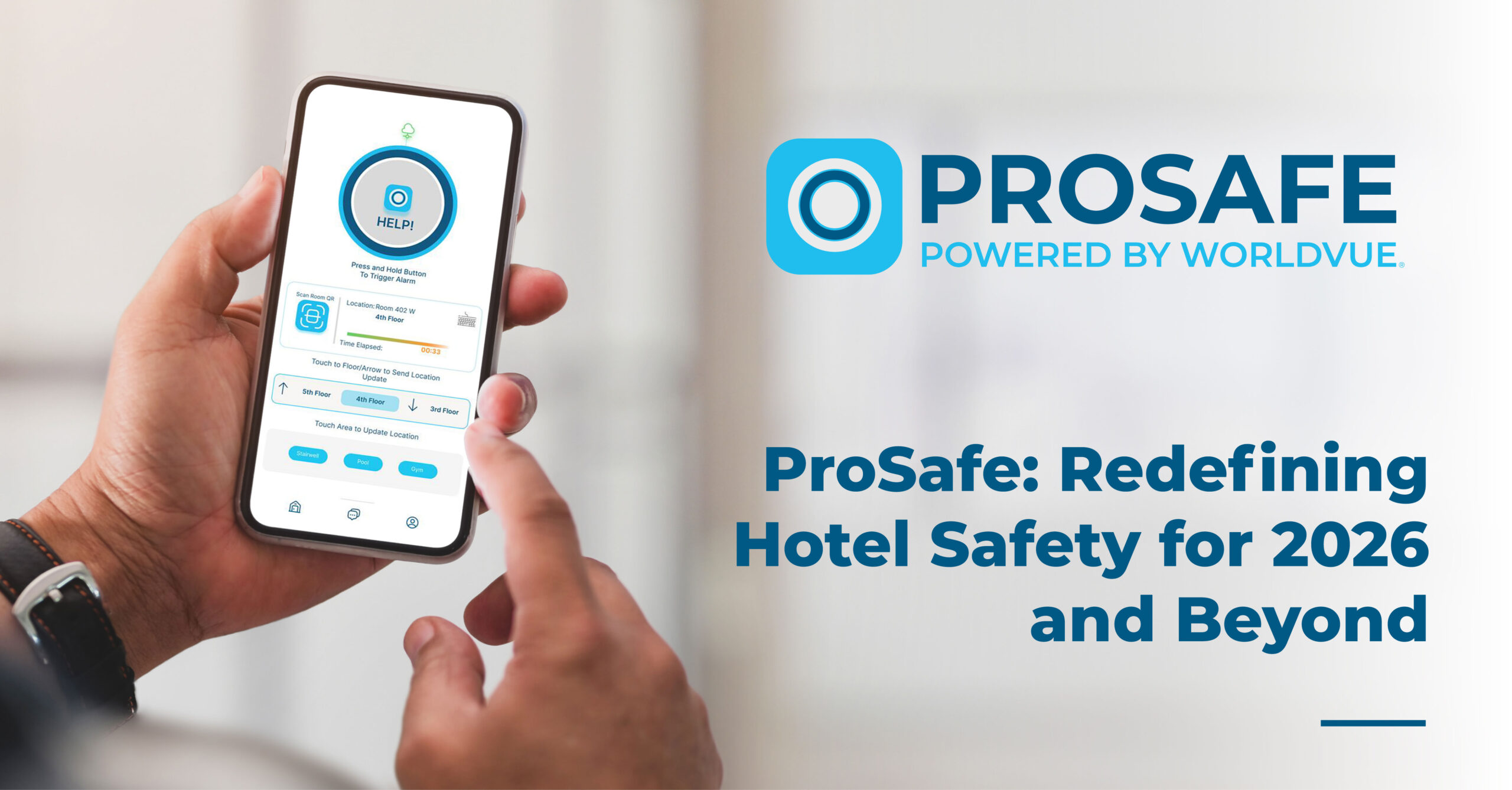
ProSafe 26 reflects that shift. This redesigned safety platform instantly connects team members, responders, and management. It provides the clarity needed for modern hotel operations and a safer working environment.
Why Hotel Safety Expectations Are Changing
Employee safety has become a permanent part of hospitality operations. Laws in multiple states require employee safety devices. Brand initiatives such as the AHLA 5-Star Promise reinforce associate protection as a shared responsibility across the industry.
State and local laws have made employee safety devices mandatory in many hotel markets in the United States. These safety regulations often apply to associates working alone, particularly housekeeping and overnight staff. While the specifics vary by jurisdiction, the direction is consistent. Hotels must demonstrate that safety systems are active, accessible, and reliable.
Brand safety standards have evolved alongside these laws. Many brands now expect more than the presence of a device. They look at response workflows, escalation paths, and documentation. In some cases, new hotels must confirm they have an employee safety solution before receiving approval to operate.
This shift changes how hotels evaluate safety platforms. Ensuring compliance alone is no longer the finish line. Hotels must show that alerts reach the right people to coordinate emergency response. They must also retain documentation to review incidents after the fact.
The quality of the system matters as much as the requirement itself.
Where Traditional ESD Models Fall Short
Many early employee safety device programs focused on a narrow use case: Press a button, send an alert, and hope the message reaches the right person.
In practice, that model creates gaps:
- Location data that stops at the floor or zone level
- Reliance on QR codes or scanning to identify rooms
- Limited context once an alert is triggered
- No direct communication between associates and responders
- Fragmented systems that do not integrate with broader operations
These limitations slow response and increase uncertainty at the exact moment clarity is needed.
Room-Level Accuracy without Beacons or Scanning
ProSafe 26 addresses one of the most persistent challenges in hotel safety: location accuracy.
Many employee safety systems rely on beacons or manual scanning to identify a location. In hotel environments, those approaches introduce risk. Beacons require installation, maintenance, and periodic replacement. Scanning depends on associate action during stressful moments, when it’s easy to miss key steps.
SafeGrid™ is ProSafe’s patented scanless location technology that removes those failure points. It delivers automatic room- and area-level accuracy without the need for beacons, QR codes, or additional hardware.
For hotel teams, the benefit is immediate. Associates do not need to remember what to scan or where to stand. Responders know precisely where to go with consistent, room-level information every time someone triggers an alert. The system operates continuously, providing precise location data with every alert.
For hotel operators, this approach also reduces complexity. Properties do not need to manage separate infrastructure or maintain ongoing hardware investments. The system scales more easily across properties and portfolios, while maintaining accuracy at the room level. This is still uncommon among ESD solutions today.
Real-Time Communication During Active Incidents
Effective safety programs extend beyond the moment the system sends an alert. ProSafe 26 supports the full incident lifecycle, from initiation through resolution. Each event follows a clear path, with defined status updates and an end state when staff no longer need assistance.
Once an employee triggers an alert, ProSafe 26 keeps communication inside a single incident experience.
Incident history remains accessible inside the platform. Alerts, messages, and captured evidence stay connected to the original event. This structure supports follow-up conversations, internal reviews, and ongoing training. It also reduces reliance on handwritten notes or disconnected reports.
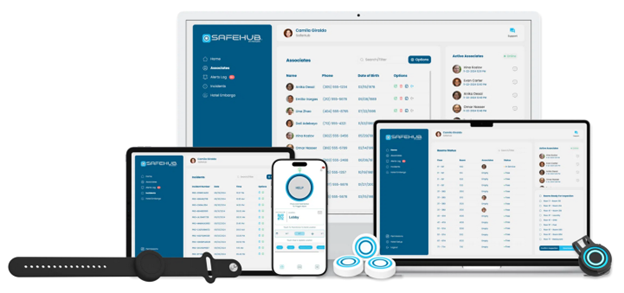
Associates and response teams can chat live within the ProSafe app or the SafeHub dashboard. Messages update in real time as responders move and coordinate. Status changes remain visible to everyone involved.
This reduces confusion and eliminates the need for parallel calls, radios, or text threads. The entire response stays aligned from the first second through resolution.
Clear closure matters. When incidents end cleanly, teams know when to stand down. Records are complete. Leadership gains confidence that safety processes are consistent and repeatable across shifts and properties.
Introducing SafeStream for Improved Insights
ProSafe 26 has added SafeStream to provide actionable insights in real-time.
This integration allows responders to see active incidents as they unfold. Video feeds provide immediate visual context, helping teams determine whether a situation is medical, security-related, behavioral, or environmental before arriving on scene.
The benefit is practical. Responders bring the right equipment. They approach with better awareness. Decisions happen sooner, not after arrival.
Video becomes a live operational tool, not just post-incident documentation.
Get Automatic CCTV Alerts Even When No One Is There to Report
ProSafe takes it even further through its partnership with TruePath Vision.
With this technology, the system can use CCTV footage to detect activity in real time and activate an alert to the SafeHub Dashboard. This means potential incidents are reported even when a human isn’t present to report them.
Any evidence captured via ProSafe is cross-analyzed with TruePath’s technology to identify a potentially bad actor, even if they have left the scene.
Direct Connection to First Responders with RapidSOS
When incidents require external emergency services, ProSafe integrates with RapidSOS to support E911 response.
Alerts can automatically share associate details, SafeGrid room-level location data, GPS information, and available evidence with public safety agencies. This replaces vague phone calls with structured, real-time data.
The result is faster handoff and clearer communication between hotel teams and first responders.
Visual Response Coordination with MappedIn
Through integration with MappedIn, SafeHub provides a real-time, interactive 3D view of the property.
Response teams can see active alerts and associate locations by floor, supporting faster navigation and coordination. This level of visibility is especially valuable in large or complex properties where spatial awareness impacts response time.
Designed for Multilingual, Modern Hotel Teams
Hotel teams are multilingual by default. ProSafe 26 reflects that reality.
The platform supports real-time translation across more than 100 languages, with voice, text, and automatic transcription. Emergency broadcasts can reach every associate in their primary language with a single command.
Clear communication reduces errors and improves safety outcomes, especially during high-stress situations.
Built to Integrate Across the Enterprise
ProSafe 26 includes two-way APIs designed for enterprise environments.
Security operations centers can ingest ProSafe data. IT systems can trigger alerts. Intelligence can flow upstream for reporting and oversight. For management companies, above-property visibility supports consistent standards across portfolios.
Safety no longer operates in isolation.
From Requirement to Operational Advantage
Employee safety devices may begin as a compliance requirement. How they perform determines whether they become an operational asset.
For hotel leadership, employee safety directly impacts risk, accountability, and operational readiness. Inconsistent response or incomplete documentation can expose gaps during audits, investigations, or legal review. A centralized platform helps reduce that exposure by standardizing how properties handle incidents.
Visibility also matters at scale. Management companies and ownership groups often oversee dozens or hundreds of properties. Without shared systems, safety performance varies by location. ProSafe 26 supports consistent standards by giving leaders insight into alerts, response times, and workflows across their portfolio.
This level of oversight supports better decisions. Patterns become visible. Training needs are easier to identify. Safety shifts from a reactive obligation to a managed operational discipline.
Take the Next Step with ProSafe and WorldVue
WorldVue helps hotels deploy ProSafe as part of a broader technology strategy. We assist properties in aligning with brand standards, operational needs, and evolving regulations.
Contact us to request a personalized demo to see how ProSafe 26 supports safer teams and stronger operations.